

Rare Breed FRT: The Drop-In Auto Trigger That’s Shaking Up the Firearms World
Rare breed frt is a niche, hand-crafted framework for rapid response training that blends unconventional problem-solving drills with adaptive muscle-memory loops, letting you pivot faster than cookie-cutter methods ever allow. It works by stripping away generic theory and wiring your instincts through chaotic, real-world scenarios, so the value lands in how naturally your reactions sharpen under pressure. To use it, you simply pick a core skill, run a few unpredictable reps, and then let the built-in feedback cues tighten your timing—no fluff, just raw improvement. The real payoff is turning unpredictable chaos into your default advantage.
What Exactly Is This Rare Breed FRT and How Does It Stand Apart?
The Rare Breed FRT is a forced reset trigger, but it stands apart by converting a standard semi-automatic platform into a system that resets the trigger via stored kinetic energy from the bolt carrier’s return stroke, rather than relying on your finger’s natural release. Unlike binary triggers or bump stocks, this unit uses a proprietary sear-and-cam interface that physically pushes the trigger shoe forward after each shot. The shooter only pulls; the mechanism does the resetting, producing a cyclic rate that mimics full-auto. What makes it distinct is its direct mechanical linkage—no inertia, no spring-assisted bounce—giving you predictable, repeatable reset timing that feels crisp and intentional. This differs from drop-in auto sears, which alter the fire-control group’s geometry wholesale. The Rare Breed FRT keeps the original hammer and disconnector, meaning it’s a drop-in replacement that retains standard parts compatibility while offering a unique, hands-on reset feel you cannot replicate with aftermarket trigger springs.
Defining the Core Mechanics Behind This Drop-In Trigger System
The heart of this drop-in trigger system is a clever reinterpretation of the sear geometry. Instead of a standard trigger reset that relies on your finger’s full forward release, the Rare Breed FRT uses a curved, spring-assisted lever that *forces* the trigger shoe forward the instant the bolt carrier group cycles rearward. That forward kick re-engages the sear without any conscious finger movement, letting the shooter simply hold steady pressure and let recoil do the work. The disconnect is timed so the hammer falls immediately after the bolt locks, creating that fast, bump-fire-like cadence while keeping the trigger pull weight surprisingly close to a standard AR trigger. You just drop it in, and the inherent mechanical interaction handles the rest.

Key Differences Between This Forced Reset Design and Standard Triggers
The core of the difference lies in how the trigger resets. A standard trigger uses spring pressure to push the trigger forward after each shot, meaning your finger must release fully before the next pull. The Rare Breed FRT uses a forced reset mechanism driven by the bolt carrier’s forward motion—this physically shoves the trigger back into position without requiring a full finger release. In practice, you keep steady rearward pressure on the trigger, and the gun resets itself. This creates a much faster shooting cadence than a standard trigger, while still firing only one round per pull—unlike a binary trigger, which fires on both pull and release. The key sequence is:
- Pull trigger, hammer drops, round fires.
- Bolt cycles forward, pushing trigger shoe forward (reset).
- You maintain pressure, so the sear re-engages instantly for the next shot.
Standard triggers require you to manually manage that reset ps90 frt trigger timing, which slows you down. The FRT removes that variable, making your shooting rhythm much more consistent and rapid.
Why the Term “Rare Breed” Matters for Your Build’s Performance
The term “Rare Breed” isn’t marketing flair—it’s a direct signal of the trigger’s mechanical specificity, which dictates how your entire build cycles. A genuine Rare Breed FRT uses a proprietary, two-stage sear geometry that resets via bolt carrier momentum, not spring tension. That distinction matters because your buffer weight, spring rate, and gas port size must be tuned to that exact timing window. If you swap in a standard mil-spec buffer, the bolt outruns the trigger’s reset, causing dead triggers or hammer-follow. Matching your buffer and gas system to the Rare Breed’s reset curve ensures every shot fires with consistent lock time. A “lookalike” FRT with different internal angles will mp5 frt trigger demand a completely different recoil impulse, so the label tells you which tuning map to use. Build with this term in mind, or you’ll chase malfunctions that aren’t the trigger’s fault.
The term “Rare Breed” matters because it identifies the exact reset timing and sear geometry your buffer, spring, and gas system must match for reliable, full-speed function.
How to Install and Set Up Your Forced Reset Trigger for First-Time Users
Begin by ensuring your rare breed FRT is compatible with your lower receiver’s pin holes, as some mil-spec tolerances require a slight fit adjustment. First, drop the hammer and disengage the upper from the lower, then remove the existing trigger group and hammer spring. Install the forced reset trigger carrier into the receiver, aligning the sear plate with the trigger pin channel. Insert the trigger pin, followed by the hammer pin, ensuring the rare breed’s dual-stage linkage sits flush against the lower’s shelf. Lubricate the sear contact points sparingly—over-oiling causes sluggish reset. Reattach the upper and manually cycle the charging handle to verify the trigger resets without binding. Finally, adjust the set screw on the trigger blade to eliminate over-travel, then test-fire with a few rounds to confirm a crisp, forced reset cycling. If the hammer follows, re-check pin alignment and spring orientation.
Step-by-Step Fitment Guide for AR-15 and Compatible Lower Receivers
Begin by confirming your lower receiver is mil-spec, as drop-in forced reset trigger fitment for AR-15 lower receivers assumes standard pocket dimensions. Remove the hammer and trigger pins using a punch, then align the Rare Breed FRT unit’s trigger and hammer holes with the receiver’s pivot points. For compatible lowers with slightly tighter tolerances, apply light pressure to the rearward spring while seating the rear pin first, then the front. Ensure the disconnect tab clears the hammer’s cam surface—if resistance occurs, do not force it; instead, re-check that the trigger shoe sits flush against the lower’s grip tang. Most aftermarket billet lowers require a 0.010–0.020-inch shim under the trigger’s rear lug to prevent over-rotation. Cycle the charging handle slowly to verify the hammer resets without rubbing the receiver walls before firing.
Necessary Tools and Tuning Adjustments for Reliable Cycling

For reliable cycling with your Rare Breed FRT, a 3/32-inch punch and a non-marring hammer are necessary to drift out the trigger and hammer pins without scarring the receiver. A torque wrench set to 25 in-lbs for the grip screw prevents frame flex that alters sear geometry. After assembly, tune the disconnect spring tension—if the trigger fails to reset, slightly increase spring preload by bending the legs outward; if the hammer follows, reduce preload. Lubricate the contact surfaces with a light grease, not oil, to avoid hydraulic drag. A function check with snap caps validates the adjustment before live fire.

- Use a roll pin punch set, never standard punches, to avoid mushrooming pins.
- Adjust the disconnect leg angle in 5-degree increments to fine-tune reset force.
- Verify the hammer catches at full cock with the upper receiver half-closed; if not, increase spring tension.
Common Installation Mistakes That Cause Misfires or Double Singles
Incorrect hammer pin alignment is the most frequent culprit behind misfires or double singles in a Rare Breed FRT, as even a slight cant prevents the trigger’s sear from resetting consistently. Over-tightening the trigger mounting screws distorts the housing, causing the bolt carrier to drag and interrupt the forced-reset cycle, which manifests as a skipped shot or a sudden pair. Conversely, installing the trigger return spring with reversed tension creates a dead trigger after the first round, since the hammer fails to catch reliably. Another subtle error is failing to recheck the disconnector engagement after firing a few test rounds, as the initial carbon buildup can shift a marginal fit into a malfunction zone. Finally, using a non-spec hammer profile—rather than the required lightweight, flat-faced design—adds inertia that stalls the carrier’s momentum, producing unpredictable single shots instead of a continuous burst.
Misaligned pins, overtightened screws, reversed springs, and incorrect hammer profiles directly cause misfires or double singles by disrupting the forced-reset timing.
Getting the Best Feel: Adjusting Your Trigger Pull and Reset Characteristics
The rare breed FRT’s forced-reset mechanism https://rarebreedtriggertx.com/ lives or dies by its trigger feel, and dialing it in means chasing a specific, violent cycle. Start by adjusting trigger pull weight—too heavy and the sear drags, stalling the reset; too light and the hammer follows, killing the forced action. You want a crisp, short release around 3.5–4.5 pounds, but the real secret is the reset characteristics: the trigger must snap forward with enough authority to re-engage the trip lever. Polish the contact points where the trigger shoe meets the disconnect, then tune the over-travel screw until there’s zero slack after the break but before the reset—that’s the sweet spot for a stable firing grip. Test by slow-firing a single round: if the trigger doesn’t audibly click back, increase the return spring tension, not the pull weight. Your finger should ride the shoe, never chase it.
Finding the Right Spring Tension for Your Shooting Style and Ammo Type
Matching spring tension for your shooting style and ammo type in a rare breed FRT starts with measuring your trigger’s reset force using a gauge, not guesswork. Light target loads with soft primers require lower hammer spring tension to avoid primer cratering and ensure reliable ignition without bolt bounce. For hot NATO-spec ammo, increase tension incrementally—usually ¼ turn on the spring retainer—until the bolt fully cycles without short-stroking. Your shooting cadence matters: rapid bump-fire demands tighter reset to prevent slam-fires, while slow precision shots tolerate a lighter pull. Test in sequence:
- Fire five rounds with factory tension and note reset lag.
- Adjust spring ¼ turn and repeat, checking trigger return speed.
- Switch to your second ammo brand and verify no ignition hang-ups.
The final setting should produce a crisp, audible reset that feeds both your physical rhythm and the cartridge’s pressure curve.
How to Smooth Out the Forced Reset Bump for Faster Follow-Up Shots
To smooth out the forced reset bump for faster follow-up shots with a rare breed FRT, focus on maintaining a consistent, firm grip pressure rather than milking the trigger. The bump originates from the carrier’s forward force resetting the trigger; you can reduce its harshness by optimizing your trigger finger placement—position the pad slightly higher to minimize muzzle dip. Then, practice a controlled, steady pull that does not fight the reset cycle, allowing the bolt to do the work. For a clearer sequence:
- First, tune the hammer spring tension to a lighter setting if compatible, reducing the forward push you feel.
- Second, lubricate the trigger group and carrier rails with a light oil to cut friction-induced bounce.
- Third, use a support-hand pull backward into the shoulder to counter the upward force, keeping the reticle steady.
- Finally, dry-fire to memorize the reset point, then transition into live fire, letting the bump guide your rhythm rather than resisting it.
This reduces the perceived jolt and tightens shot-to-shot timing.
Lubrication Points and Maintenance Routines That Prolong Component Life

For your Rare Breed FRT, the trigger group’s sliding surfaces and sear engagement points are the primary wear zones. Apply a thin, high-pressure grease to the FRT’s cam track, the bolt carrier’s trip lug contact patch, and the trigger pin bores every 500 rounds. Wipe down the disconnector nose and reset ramp with a dry film lubricant—never oil, which attracts carbon. After each range session, flush these lubrication points with a solvent spray, then reapply a minimal grease layer. Replace the trigger return spring every 3,000 rounds; its fatigue alters reset timing and increases friction. A routine of cleaning the hammer pocket and polishing the sear edges with 800-grit stone every 2,000 rounds prevents premature galling and maintains a crisp break.
Practical Shooting Drills and Techniques to Maximize Your Forced Reset Capabilities
To maximize your Rare Breed FRT’s forced reset potential, master the trigger-index finger isolation drill. Press the trigger only to the wall, then allow the carrier’s forward momentum to reset it—do not consciously release. Practice the controlled pair cadence at 5 yards, focusing on a sharp, short pull per shot, letting the bolt’s return slam the sear. For recoil management, adopt a high-thumb grip and lean slightly into the rifle to prevent muzzle climb from breaking your sight picture between resets. Run the failure drill (two to body, one to head) at 7 yards, counting every shot as a single discrete press rather than a burst. Finally, use a shot timer with a par time of 0.15 seconds between shots to train your finger to stay glued, letting the FRT’s mechanism do the work—your only job is maintaining pressure and sight alignment.
Controlling Muzzle Rise During High-Speed String Firing

Controlling muzzle rise during high-speed string firing with a forced reset trigger demands a rigid support-hand grip that drives the gun forward into the lockup, not upward. Your stance must shift weight slightly onto the balls of your feet, letting the upper body absorb the cyclic recoil impulse before it can torque the muzzle off target. Compensated slide velocities require a firm wrist lock to keep the front sight tracking horizontally through the burst; any slack invites vertical climb that compounds with each round. Canted support-thumb pressure against the frame’s dust cover helps counter the natural rotational torque. For sustained splits, re-index your visual focus on the front sight’s post rather than the target, letting the dot or blade return to the same elevation before the next trigger reset.
- Maintain a 60/40 forward pressure ratio between support and wot trigger firing hands.
- Use a low, aggressive grip high on the backstrap to reduce pivot leverage.
- Drive the muzzle slightly downward at the start of each string to offset cumulative rise.
How to Train Your Support Hand Grip to Prevent Unintended Bump Fire
To prevent unintended bump fire with a Rare Breed FRT, train your support hand grip to apply firm, rearward pressure against the forend while keeping your firing hand’s trigger finger isolated. Your support hand must act as a fixed anchor, resisting the receiver’s forward thrust after each shot, which stops the trigger from resetting off your finger. Practice dry-fire repetitions, pressing the support hand into a wall or barricade, to ingrain this isometric tension. Avoid a loose, cupped grip that allows the rifle to slide. Focus on stabilizing the support-hand grip pressure so your firing hand remains passive, letting the trigger reset only from the bolt’s rearward motion, not from hand movement.
Train your support hand to lock the rifle rearward, keeping tension constant, so the FRT’s forced reset never becomes an uncontrolled bump fire.
Dry-Fire Practice Methods That Improve Your Control Without Spending Ammo
Dry-fire practice isolates the trigger mechanics of your rare breed FRT without burning ammunition, allowing you to refine finger placement and reset timing. Use a laser-training cartridge to trace your sight picture during rapid trigger resets, confirming that the muzzle remains stable through the forced-reset cycle. Focus on a controlled trigger-press progression, indexing your trigger finger to the exact reset point between shots, minimizing excess movement. Incorporate a shot timer app to track split times, aiming for consistent sub-second intervals that mirror live-fire cadence. For deeper analysis, pair dry-fire with a high-speed video recording to examine trigger return and grip tension, as shown below.
| Method | Control Benefit | Key Focus |
|---|---|---|
| Laser cartridge | Visual trace of muzzle drift | Maintain dot on target through reset |
| Reset-point indexing | Reduces over-travel | Stop trigger precisely frt 15 trigger at wall |
| Shot-timer drills | Cadence consistency | Match forced-reset rhythm |
Fixing Common Malfunctions and Fine-Tuning Ammunition Compatibility
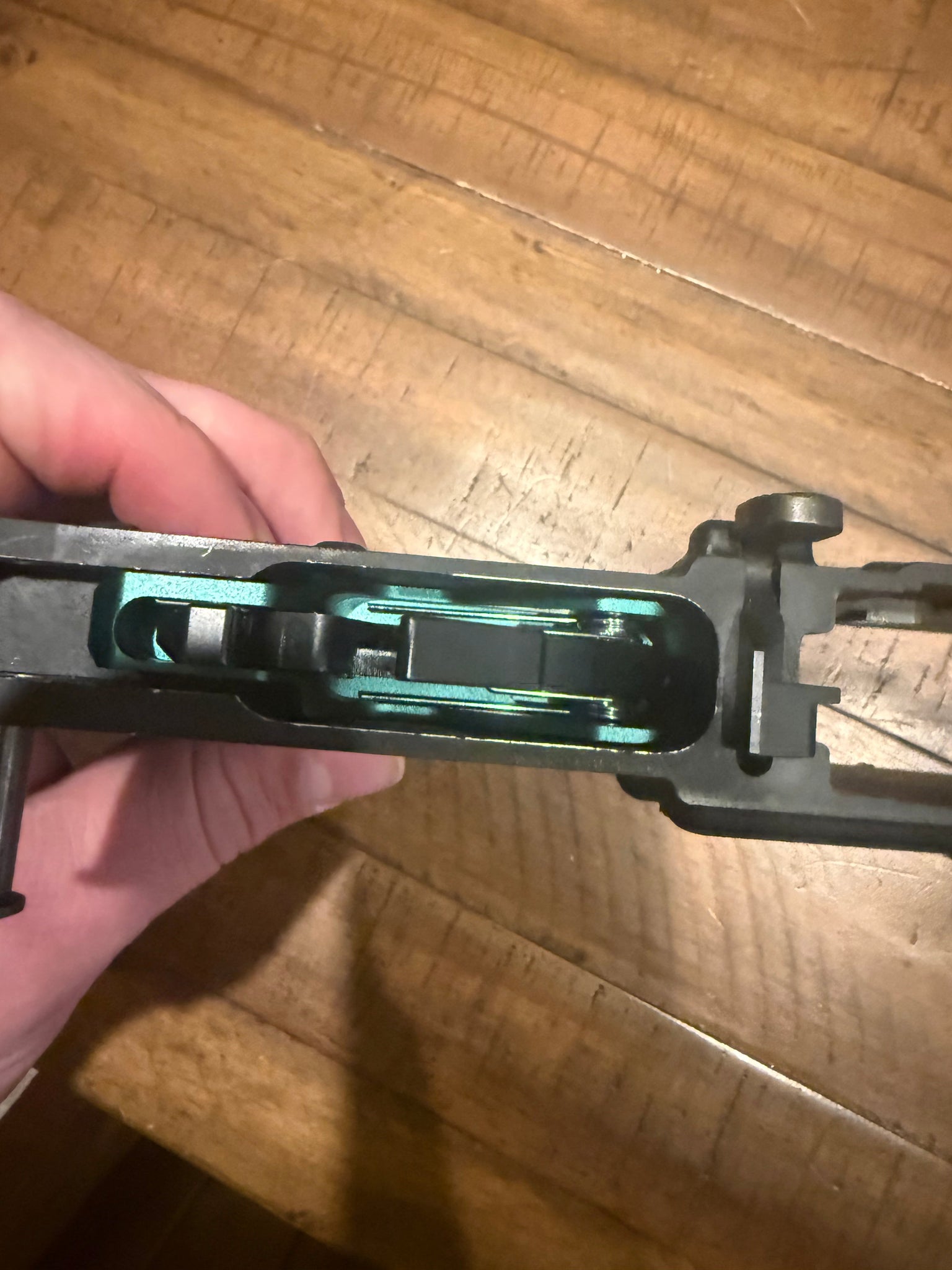
When your Rare Breed trigger starts skipping reset, the first thing I check is the hammer spring tension—a weak spring causes light primer strikes that mimic ammunition issues, so replace it before blaming your ammo. For fine-tuning compatibility, I sort cartridges by rim thickness; thinner rims let the bolt carrier over-ride the sear, so I seat rounds deeper in the mag or switch to a heavier buffer to slow carrier velocity. If you get double-fires with hot NATO loads, the trigger’s disconnect needs a tiny file pass on the engagement face—just a few strokes, then test with cheap brass. That said, a finicky batch of steel-cased ammo with hard primers will always need you to swap in a stronger firing pin spring, not the trigger itself. Finally, polish the bolt’s cam pin groove—rough machining there makes the carrier bounce, which the FRT reads as a trigger reset, so you’ll chase phantom malfunctions until that friction is gone.
Why Light or Weak Ammo Causes Short Strokes and How to Counter It
A light or weak round—such as reduced-recoil or underpowered ammunition—fails to generate sufficient port pressure within the gas system to fully cycle the Rare Breed FRT’s internal components. The bolt carrier cannot travel far enough rearward to reset the trigger’s sear trip, resulting in a short stroke failure where the hammer follows the bolt. Counter this by increasing gas flow: install a lighter buffer, reduce buffer spring preload, or open the gas port if adjustable. Additionally, ensure the bolt carrier group is properly lubricated, as friction compounds the low-pressure condition. Finally, verify the rifle’s ejection pattern—weak ejection indicates you need more aggressive tuning before the FRT will reliably reset.
Light ammo lacks the gas pressure to fully cycle the Rare Breed FRT; counter it by lightening the buffer, reducing spring tension, or increasing gas flow, so the bolt travels far enough to reset the trigger.
Identifying Wear Signs in the FRT Cam and Carrier That Need Immediate Attention
Inspect the FRT cam’s contact surfaces for flattened lobes or a shiny, polished wear line that rare breed triggers in stock indicates material loss beyond normal break-in. On the carrier, check the rear lug and cam pin track for galling, pitting, or step-like ridges—these catch the pin and cause delayed reset. Immediate attention is required if you see metallic shavings in the receiver, a visible burr on the cam’s ramp edge, or if the carrier’s track shows uneven, deep scoring that catches a fingernail. Also, measure carrier-to-cam clearance; excessive play with bright metal-on-metal contact signals imminent seizure. Stop use and replace parts if any crack propagates from the cam’s pin hole or carrier’s lug base.
Flattened cam lobes, pitted carrier tracks, galling, and cracked lug bases are immediate-replacement wear indicators that risk FRT failure.
Do’s and Don’ts for Mixing the Trigger with Heavy Buffers or Suppressors
When pairing a Rare Breed FRT with heavy buffers, verify the buffer weight against the carrier’s captive pin channel before firing. A standard carbine buffer (H1) is the safe baseline; moving to H2 or H3 increases bolt velocity reduction, which can cause the trigger’s trip lever to outrun the carrier’s return stroke, inducing hammer-follow or slam-fires. Do use a suppressor only if you also shorten the gas system’s dwell—long dwell with a heavy buffer creates carrier bounce, resetting the FRT mid-cycle. Don’t add a tuning weight to the carrier while retaining a suppressor; the added mass delays the sear reset beyond the bolt’s unlocking window. Do test with snap caps to verify hammer re-engagement before live fire. Don’t mix a 9mm-specific buffer with a 5.56 FRT, as the shorter stroke misaligns the trigger’s reset pawl.
Stick to H1 buffers, avoid suppressor-induced carrier bounce, never stack carrier mass with a can, and always test reset with dummies first.